Chapter 1 · Lesson 1
Consideration and parts of the road
After this lesson, you can
- explain what consideration (hänsyn) requires of you, even when you have right of way
- name the four groups who get extra care — and why cyclists are not on that list
- tell road (väg), carriageway (körbana), lane (körfält) and hard shoulder (vägren) apart
- decide when a car may use the shoulder, and who yields when you rejoin the carriageway
1. What consideration actually requires
Every road user must take the care and caution the situation needs, so that nobody is put in danger. That duty sits at the front of the traffic ordinance, before the rules about signs, lanes and give-way. If two cars meet and one of them “had priority,” the crash can still be the result of driving badly.
The same paragraph also says you must not hold others up or disturb them without a good reason, and you must show consideration to people who live along the road. Those are not extra manners. They are the same duty as “do not cause a crash,” written out in full.
In practice that means: slow when you cannot see far enough to stop; leave cyclists a real gap instead of squeezing them toward the kerb; keep the horn and headlight flashes for genuine warnings, and keep them short; and do not use the car as a noise machine outside someone’s window at night. A greeting on the horn is not a warning. It is a disturbance the law names.
2. Extra care is a closed list of four
Everyone in traffic gets your ordinary care. Four groups get extra care on top of that. The list is closed. If you add people who are merely hard to see, unprotected, or surprising, the extra-care answer is wrong — even though those people still deserve ordinary care.
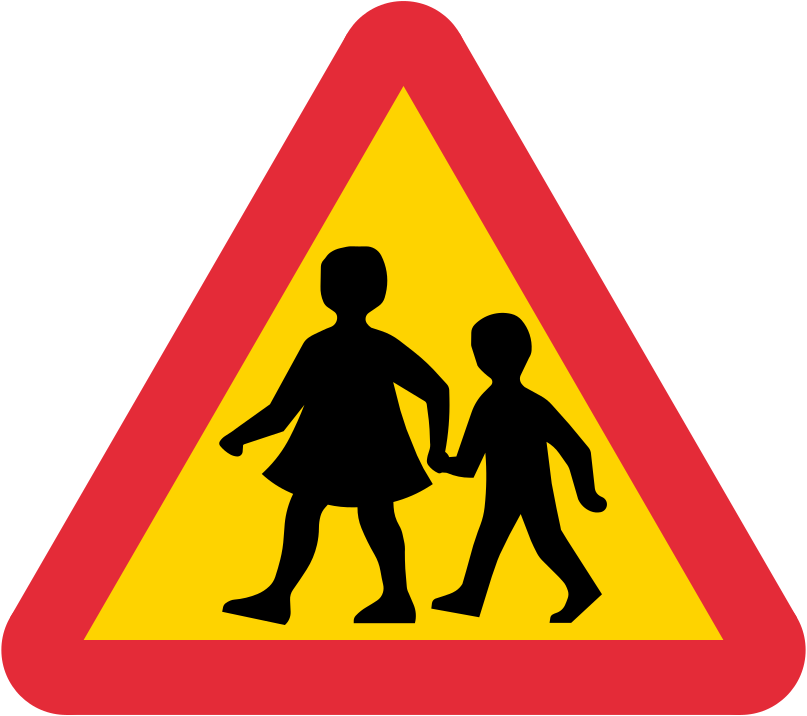
Cyclists, joggers in dark clothes, a funeral procession, someone stepping out from between parked cars — you still look out for them. They are not on the extra-care list. Questions that say “who must you show särskild hänsyn to?” want the four names, not a longer safety speech.
Example
Children, 50, no warning sign
Dry afternoon, signed 50. Children are playing with a football on the pavement to your right. The ball rolls toward the kerb. There is no pedestrian crossing and no A15. You are doing 49.
Answer: Come off the gas and cover the brake. Be ready to stop. Forty-nine can still be too fast.
Children are on the extra-care list whether or not a warning sign is posted. A 50 sign is a maximum, not a speed you must hold. The test is whether you could stop if a child followed the ball without looking. Most drivers cannot do that from 49.
Who gets extra care (särskild hänsyn) by name?
Pick one answer to see why.
3. Nearby duties that get mixed in
A few other rules sit next to consideration and often appear in the same questions. They are not the extra-care list, but they are the same idea in a more specific form: slow down around people who are getting on or off, and do not box them in.
- When a bus, tram or school transport has stopped for passengers, reduce speed. If the speed limit is 50 km/h or lower and the bus signals to leave the stop, let it out.
- If you pass a stopped bus or tram on the right and there is no island between you and it, stop and leave a clear path for people getting on and off.
- Give cyclists enough side room that a wobble does not put them in the gutter. Squeezing someone is the “unnecessary danger” the consideration rule talks about.
4. Four words that nest inside each other
English speakers often treat “road” and “carriageway” as the same strip of asphalt. Swedish does not. The exam will point at one layer and ask about the rule that belongs to another. If the words are synonyms in your head, the answer will be wrong.
A useful picture: stand on a two-way country road. Pavement or grass at the edges, then a strip of gravel, then asphalt with a centre line. The whole width is the road. The asphalt files of cars are the carriageway. Each file is a lane. The gravel is the shoulder. Ditches and the field beyond are not “the road.”
A cyclist rides on the hard shoulder (vägren). Is she on the carriageway (körbana)?
Pick one answer to see why.
5. Who the shoulder is for
Your car belongs on the carriageway, usually in the rightmost suitable lane. The shoulder is for slower and more exposed road users. When it is wide enough and suitable, expect to meet cyclists and class II mopeds if there is no cycle path; class I mopeds; slow vehicles built for a maximum of 40 km/h, or that cannot go faster; horse-drawn vehicles, riders, and people leading animals; and pedestrians when there is no pavement. Pedestrians walk on the left, in their direction of travel, when they are on the shoulder or carriageway.
Example
Rejoining after a brief pull-in
Two-way 70 road with a wide, empty shoulder. A van catches up from behind. You ease partly onto the shoulder to give room, then start to move back. A car is already in the lane, level with your rear bumper.
Answer: Stay on the shoulder and let that car pass first.
Helping the van was allowed. Returning to the carriageway is not a merge where both sides share the adjustment. You yield to traffic already on the carriageway, sign or no sign.
You eased onto the shoulder to help. Now you want back in. Who yields?
Pick one answer to see why.
6. Built-up area: what E5 changes
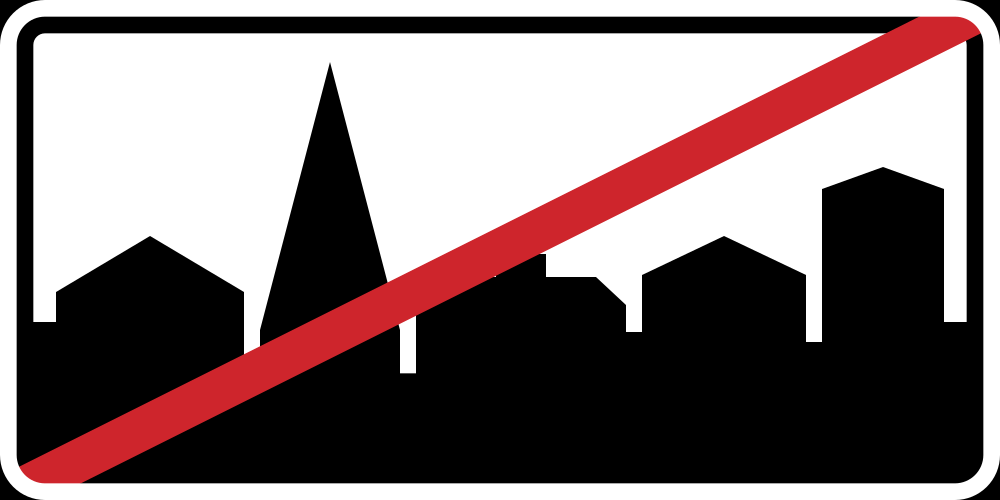
The sign E5 marks a built-up area (tättbebyggt område). That is a legal decision in a local regulation, not a judgement that “it looks like a town.” From E5, the default speed limit is 50 unless another speed sign says otherwise. People will also be closer to your lane, even where there is a pavement. The speed lesson covers how far to drop; the point here is that 50 is a ceiling, and extra care still applies under it.

Example
Horn at night on a quiet street
You drive through an E5 area late at night. It is quiet. A friend asks you to sound the horn briefly as you pass their house.
Answer: Do not sound the horn.
The horn may only be used briefly to prevent or avert danger. A greeting is not danger, day or night. Consideration to people who live by the road is a separate duty in the same opening paragraph.
E5, no other speed sign, children near the kerb. What do you do?
Pick one answer to see why.
7. Who belongs where
| Place | Cars | Cycles / mopeds | Pedestrians |
|---|---|---|---|
| Where each road user belongs | |||
| Carriageway (körbana) | Yes — rightmost suitable lane | If no cycle path or suitable shoulder | Only if no pavement or shoulder |
| Hard shoulder (vägren) | Only briefly, to help others | Yes if suitable (class II: when no cycle path) | Yes if no pavement — walk on the left |
| Cycle path (cykelbana) | No | Yes (cycles and class II mopeds) | Only if no pavement or shoulder |
| Pavement (gångbana) | No | Children through the year they turn 8, if no cycle path | Yes |
8. Common mistakes
- Consideration is politeness, after the real rules.It is the opening rule. Priority never switches it off.
- Extra care means cyclists and anyone hard to see.Children, older people, school wardens, and an apparent disability or illness. Everyone else still gets ordinary care.
- Väg and körbana are two words for the asphalt.Väg is the whole width. Körbana is the vehicle part minus the shoulder and the cycle path.
- No paint, no lane.A strip wide enough for one file of four-wheeled vehicles is a lane, painted or not.
- The shoulder is a slow lane for cars.It is not a lane for cars. A brief help-visit, then back — and not even that if the edge line is solid.
- Traffic should let me back in from the shoulder.You yield to vehicles already on the carriageway. Every time.
- E5 means 30 near children, or means nothing.E5 means built-up area, default 50. Children mean you adapt below that ceiling.
- A short hello on the horn is harmless.The horn is a danger warning. Residents are named in the law.
Official source: Transportstyrelsen — Generella trafikregler (hänsyn)
Official source: Transportstyrelsen — Gående
Official source: Trafikförordningen (1998:1276) 2 kap. 1 §; 3 kap. 12, 15, 21, 45, 58, 64 §§; 4 kap. 7–8 §§
Official source: Förordning (2001:651) om vägtrafikdefinitioner — väg, körbana, körfält, vägren
Sign artwork: public domain (Transportstyrelsen). Lesson text is a MinKörkort study draft — not the official legal wording.